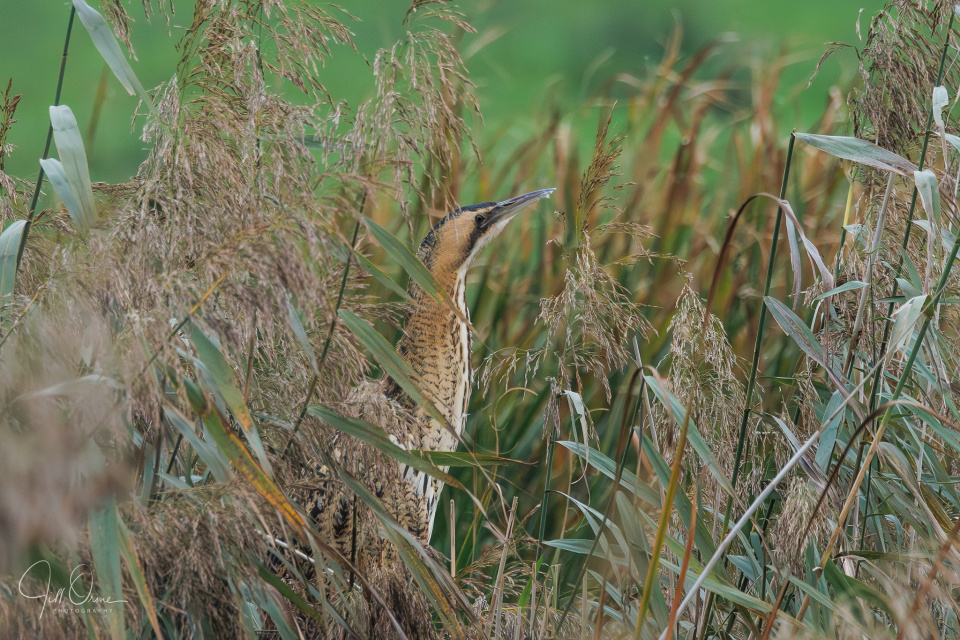
I really love a Bittern. I love all herons actually, providing they’re not fishing in my ponds, because they’re so elegant, poised, and aloof. But Bitterns take heron-ness to another level, by being secretive and enigmatic as well. They share these last two qualities with Short-eared Owls, of which, as you may be aware unless you’ve been avoiding me on social media over the past few years, I’m also very fond. But while the Short-eared Owl has done itself no favours recently by becoming an internet sensation, leading to some unbecoming scenes at its best-known winter feeding sites, the Bittern, while no longer critically endangered in the UK, remains elusive, hard to spot, and even when you’ve found one, surprisingly tricky to photograph.
The WWT staff at Slimbridge reckon there are three Bitterns in residence there at the moment, and they’ve been showing quite regularly over the past few days as they jostle for territory in the reed beds near the Zeiss hide, but I’m very doubtful that I’d have spotted this one if another member of the owling crew hadn’t seen it first, and shown me a photo on the back of his camera to help me pinpoint its position among the reeds. Then it took us several minutes to find the angle from which we could achieve the least obscured photos, which turned out to involve leaning out of a side window of the hide, and shooting along the wall. And even then, a high proportion of my shots had to be discarded, because the autofocus kept moving off the bird and grabbing onto the shifting reeds instead. None of this is unusual when it comes to photographing Bitterns, and it can be pretty frustrating, so I doubt they’ll be suffering crowds of Instagrammers any time soon.
The RSPB is pretty pleased with itself about its ongoing role in the Bittern’s return from the brink of extinction in England and Wales, and its species page, as well as being unusually discursive by RSPB standards, has some interesting facts and figures. Birdfact also has some good information, as well as excellent photos, and even though it’s a couple of years out of date, this article from the Natural History Museum is also worth a look.
For the record, the Bittern wasn’t the only good bird I found at Slimbridge today. Out of a pleasing total of 56 species, the most noteworthy ticks – both lifers for me – were a Temminck’s Stint on the Rushy Pen, and a Yellow-browed Warbler which was flocking with some Chiffchaffs in the trees near the Kingfisher hide. Less happily, I was stung by a Common Wasp, several times, through my jeans, while walking between the Warbler and the Bittern. I spend quite a lot of time speaking up for Wasps to people who hate them and believe the world would be a better place without them, but if they’re going to start repaying me with violence they’ll be needing to find themselves another advocate.