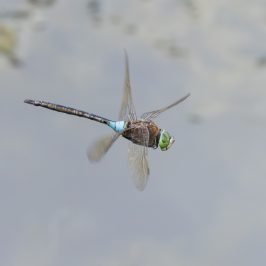
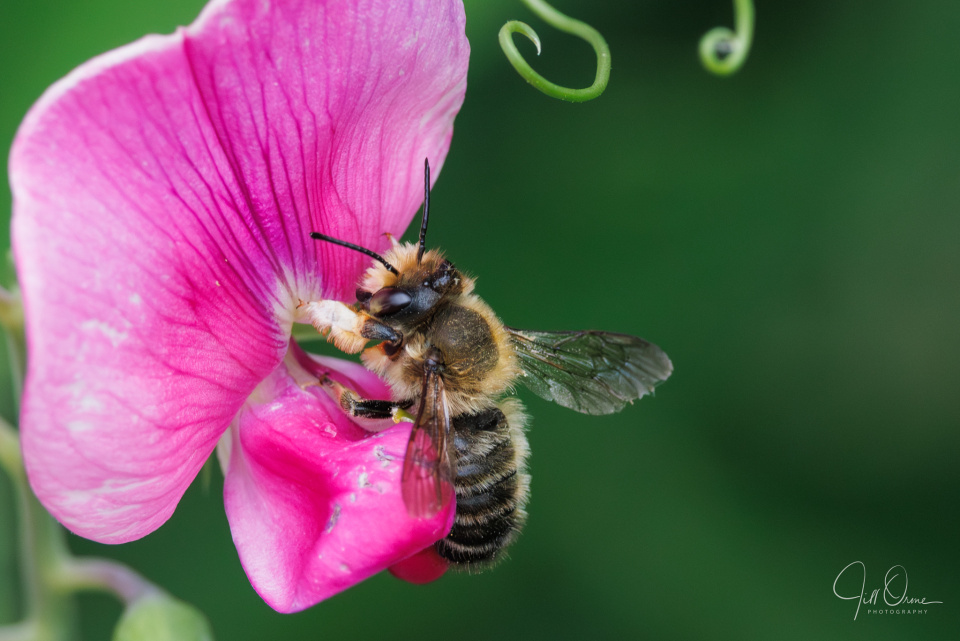
I’ve been trying for nearly a week to get a photo of this little bee, but up till now I hadn’t even got close as he zoomed relentlessly around the perennial pea in search of a female. Then late this afternoon I had to give up my own relentless pursuit of the three immature male Southern Hawkers down in the wild garden because it suddenly began raining, and on my way back to the house I paused, purely out of habit, to check the pea plant. The first thing I saw was a female Willughby’s Leafcutter Bee, obviously mated because she was foraging pollen for a nest. And then a second female, also foraging though carrying a smaller pollen load than the first. And then finally my prize: the little male, now apparently quite relaxed and happy to be followed around, as he fed from first one flower and then another.
Clearly I can’t know this, but I’m pretty sure there’s a line connecting these three sightings and the sudden dramatic change in the male’s demeanour: he’s won the Spot the Bee competition and passed on his DNA at least once, and now he can kick back a bit and enjoy a decent meal, instead of just grabbing quick drinks on the run. Some male solitary bees die quite quickly after mating, but I don’t think that’s the case with male leafcutters, because I usually find one or two hanging around the garden for several weeks in the second half of the summer. Leafcutters can be difficult to identify from photos, but Mr Willughby here (Megachile willughbiella, to give him his proper name) is very easily picked out by the fringed white boots he’s sporting on his front legs, winningly coupled with furry white shorts. There are a couple of other leafcutters whose males have similar “Look At Me!” front legs, but both are rarer, coastal species, and in any case neither of them looks exactly like this.
Even though I had plenty of opportunity to photograph my little friend this afternoon while he was gorging on pea nectar, the shape of these flowers meant that he had to push himself quite a long way inside them to reach the nectaries, and in most of my photos his distinctive front legs were at least partly hidden. But I quickly noticed that he tended to leave each bloom by stepping backwards and going into momentary free fall before starting up his wings and lifting away to the next one, so I concentrated on those moments, and after a few goes I managed to catch the the instant when he pushed off into space.
R: L2, C10, D40.