
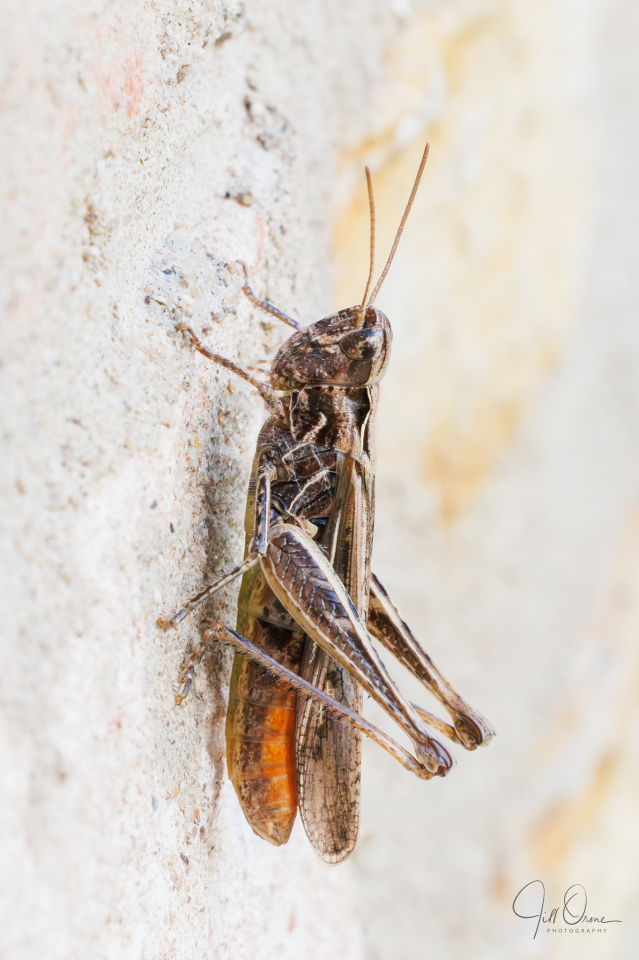
Suddenly our garden is full of Field Grasshoppers, and when you walk across the front lawn (which we’ve finally cut, though leaving half a dozen carefully curated thistles, which are just beginning to flower) they ping back and forth around your feet. Most are still tiny, but there are a few that are now fully grown, and because this is a winged species these adults can not only jump from surface to surface but can leap into flight and completely disappear, which is rather disconcerting.
For some reason these grasshoppers seem to be attracted to the house – I quite often find one perching on the door or the door frame – and I found this one in the porch, where he’d contrived to get himself completely tangled in some old cobweb at the back of one of the pillars. He was still struggling, but weakly, and after checking that I wasn’t depriving a needy spider of dinner I gently scooped him up, cleared away some of the web and then set him down on the flags. He promptly leapt, in the wrong direction, clanged face-first against a metal bin we keep in the porch for parcel deliveries, and dropped like a stone to the ground. Suspecting he’d just won himself a Darwin Award, I went over and peered at him and realised that he was actually still alive, if a bit dazed, so I picked him up again and put him on the front wall of the house. I’m happy to report that after a while he got over his discombobulation, and returned to the garden under his own steam.
By one of those odd bits of synchronicity, about an hour later I received an email saying that a parcel had been delivered for me, and as it wasn’t in the hall and R knew nothing about it, I went out to the porch and checked the bin – where I found a package from NHBS, containing the new Bloomsbury Field Guide to the Grasshoppers and Allies of Great Britain and Ireland, which they currently have on sale. It’s a very comprehensive book, really too heavy to carry in the field (honestly, I could have managed without the Cockroaches), but Richard Lewington’s illustrations are superb, and I really like the fact that each species description has a QR code that takes you to a recording of its song. It’s a huge improvement on the old photographic guide I’ve been using since I first got into this malarkey, and I’m very pleased to have added it to my library. There’s a more considered review here, if you’re contemplating buying it yourself.
R: L2, C10, D44.


