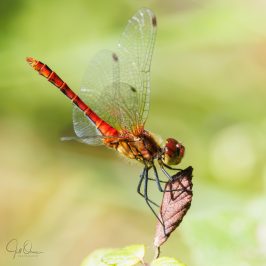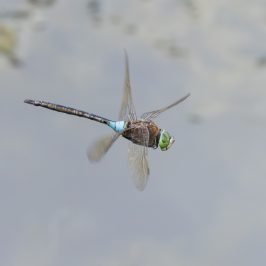

The return of warm, sunny weather brought all the remaining dragons out to play on the Avon this morning. I don’t know if they realise that their time is running out, but there’s been far more evidence of mating activity over the past week than there was earlier in the Migrant Hawker season, so it’s possible that they’re responding to an inbuilt biological clock. I saw three different pairs fly past me in cop over the space of about forty minutes, all of them disappearing into the bankside trees, and then I happened on the pair in my second photo quite by chance, while I was trying to take flight shots from the south bank of the river.

With the notable exception of Lesser Emperors, most large female dragonflies in this country oviposit alone, though you sometimes see them being guarded from a little distance away by their most recent partners. But male Migrant Hawkers like to keep hold of their mates if they can, and again that urge seems to be increasing, as the season approaches its end and competition for females hots up among the remaining males. However, the females themselves are a lot less keen on the idea: I’ve seen Migrant Hawkers ovipositing in tandem a few times now, and on every occasion the female tried repeatedly to shake herself free.
In the case of this pair I watched the female break the mating wheel and then immediately try to take off, only to end up swinging back and forth like a pendulum, as the male held fast to the reed with his claws and to her head with his claspers. After several seconds of increasingly fierce struggle she managed to break his grip and disappeared into the middle of the reed bed, and I thought that was the last I’d see of her, but a couple of minutes later I caught a glint of light and a hint of movement at the base of the reeds, and there she was. At the time there were two males circling this area and threading themselves in and out of the reeds, and if either of them had seen her she’d have been seized again and re-mated, but at least during the time I was watching she managed to keep a low enough profile to avoid being spotted. As soon as she’d laid all her eggs she will have left the river and gone back to a favoured hunting ground, and she’ll only come back to the water, and the relentlessly patrolling males, when her next batch of eggs are ready to be fertilised and laid.