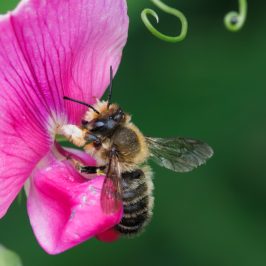

It took me a while this morning to realise that the Honey Bee sized bees noodling around the grape hyacinths weren’t actually Honey Bees at all, but Common Mourning Bees (Melecta albifrons). To be fair, this is about ten days earlier than I’ve ever seen one before, and they often don’t make themselves apparent till the first week of April – so I hadn’t been expecting or looking out for them. But after identifying the first one and getting my eye in, I began to spot them all round the garden, and it became apparent that there’d been a sudden mass emergence. By the middle of the afternoon – by which time it was 20°C down in our little valley – I’d stalked and photographed at least five different individuals.
According to Steven Falk’s species account the flight period for Melecta albifrons runs from April to June, so a Mid-March emergence is definitely on the early side. This unusual-looking bee is a cleptoparasite of the Hairy-footed Flower Bee, and as such, of course, one can only disapprove of its behaviour, but while the invasion of a Plumpie nest by a female Common Mourning Bee, and the ultimate takeover of the host nest cells by her larvae, is obviously a tragedy for the individual female Hairy-footed Flower Bee whose own breeding attempts come to nothing, the entomologists tell us that this parasitism has no effect on the Plumpie population overall. Instead they tend to regard it as a useful check, preventing too many Plumpies from colonising a particular site; and pointing out that the distribution of Common Mourning Bees is very patchy, they state that having a good number of them in a particular area is a positive sign that the Hairy-foot population there is flourishing.
Still though…. I’m entirely on the side of the female Plumpies.
R: L2, C6, D20.