It was a bright and sunny morning, so while R went off to Stratford for brunch with his visiting bros, I drove out to Farmoor in search of walking, cake, and birds. There have been several good sightings reported at Farmoor over the past few days – of birds, that is: there’s always decent cake – and I was especially hoping to see the pair of Dunlin in breeding colours that were photographed there a couple of days ago. Sadly they’d moved on again, but there were four Common Sandpipers around somewhere, I was told by a chap on the causeway, a Little Ringed Plover, the Great Northern Diver was still over there, he thought, and – oh yes – a couple of Yellow Wagtails down at the corner.
I pounced. “Yellow? or Grey?” “Ummm… yes, Grey actually. Catching insects down there.” I nodded gravely and managed not to smirk, while mentally patting myself on the back: I must have been told a dozen or more times by now that there were Yellow Wagtails somewhere about at Farmoor, and I’d never seen one yet. Still, I’d remember to keep an eye out, I thought, and maybe get better shots of the Diver than I managed last time; and with luck I’d also find the Sandpipers. We agreed that the small wader that had flown past me, squeaking in outrage, just before we stopped to chat to each other, was almost certainly the Plover – flushed off the causeway by someone, said my informant – but it had appeared to be heading to the far side of F1, and I hoped I might catch up with it there.
At this point the weather was golden and balmy, and the water was flat calm, but my attention was caught by some black cloud over to the west, trailing pillars of rain. “Which way is that moving, do you suppose?” I asked. My new acquaintance turned and looked, then consulted his phone. “This way,” he replied, “but I think it’s going to miss us.” Having all too much experience of getting caught out in the open at Farmoor by fast-moving weather, I didn’t think anything of the kind, and I noted that he didn’t look too confident either, setting off back towards the café and the car park at a fast clip. I headed the opposite way at equivalent speed, and was thus within striking distance of the Pinkhill hide when the rain storm hit. And there I sat for the next half hour, watching water bouncing off water, until the drops slowed down and spaced out, and the songbirds started up again. Then back out into more bright sunshine, and on around F1, where the Plover remained elusive but the Diver gave me some quite nice shots. Every now and then the Sandpipers – down to three by this point – would fly past me in a funk because someone on the reservoir edge had looked at them a bit funny, and it was obvious that they were going to be tricksy.
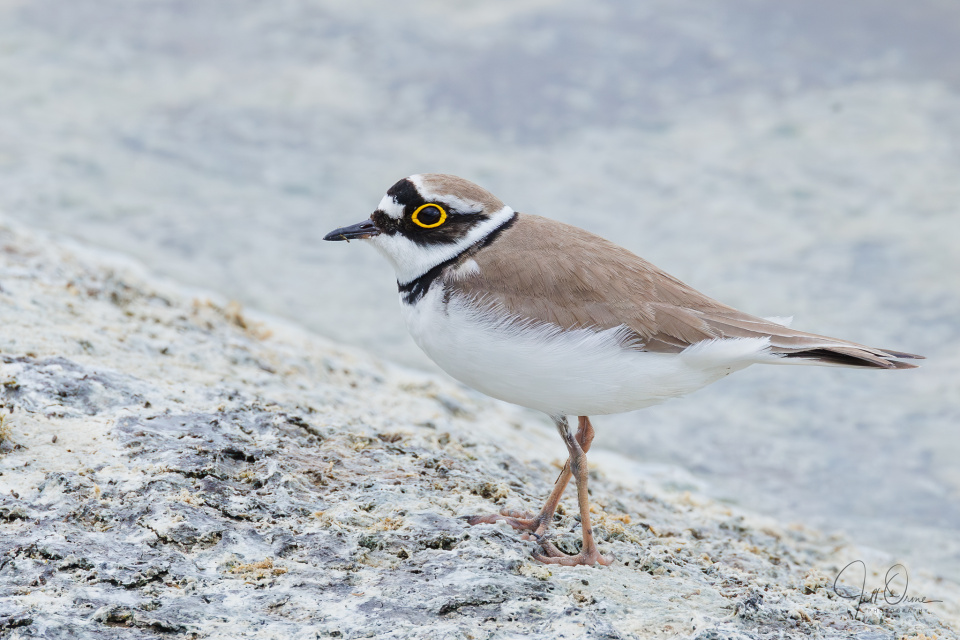
I finally caught up with the Little Ringed Plover (LRP in birding parlance) an hour later, back on the causeway by the beached mussel cages, just about where I’d had my first blurry sighting of it. The last time I photographed an LRP at Farmoor, back in the late summer, it was a flighty juvenile, and this is an adult in breeding plumage, but its demeanour was much the same – nervy and irritable – so slow and careful stalking was required for me to get as close as this. According to my ancient Latin dictionary, the species-specific name dubius means uncertain, irresolute or indecisive, and that sums it up pretty well. Still though, it’s an attractive little bird, and I thought it was worth taking a bit of trouble over. This individual is most likely inbound after wintering in Africa, heading for one of the inland man-made wetlands the LRP now favours for breeding – which in theory could include Farmoor, though I think that if the species was resident here it would be seen and reported far more frequently than it is. But reservoirs, flooded gravel pits and even sewage works are all cited as likely breeding territories, and although some sources say that numbers on the Continent are falling, in the UK the Little Ringed Plover is doing so well that it’s currently Green-listed.
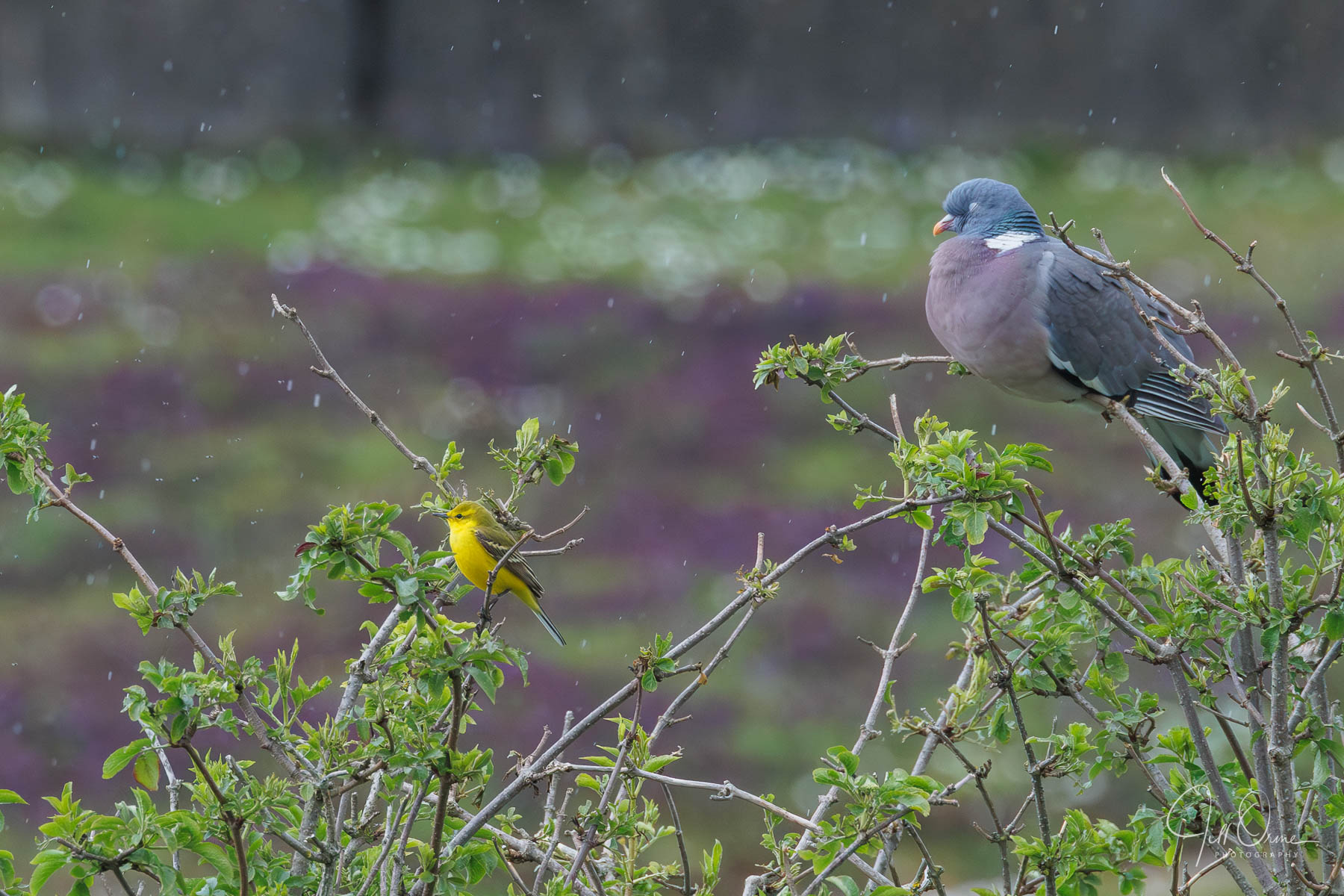
As I was tiptoeing up and down the causeway after my quarry I realised that there was another weather system coming in from the west, and once I’d nailed this shot and a few others I left the LRP skittering about and feeding, and set off back towards the café. A man striding out the other way hailed me, and asked which way I thought the rain was heading. “This way,” I said with confidence, “but you’ll probably make it to the hide before it arrives.” “Ugh,” he said. “Have you any idea where the Little Ringed Plover is?” I gave him specific directions, and he thanked me and offered a more than fair exchange: “When you get to the end of the causeway, look for a small tree with a Woodpigeon in it, over towards the sewage plant – I just photographed a Yellow Wagtail there.” Despite my ingrained suspicion of Yellow Wagtail reports at Farmoor, for some reason I believed this one, and as you’ll see from my second image, it turned out to be true: it’s a distant photo, taken in poor light and rain, and it’s far from my best work, but that is unquestionably a Yellow Wagtail. It was the seventh and last of the new-for-year birds I added to my list today, but because it’s Red-listed, probably the most pleasing.
R: L2, C8, D4.


