I had to go to Coventry this afternoon, so I took a mid-morning trip to Cleeve Prior Mill, hoping to get the day’s photos wrapped up beforehand. Neither of my two current target species has turned up yet, but the clearing was teeming with Banded Demoiselles and other damselflies, going up in clouds around me as I pushed into the nettle beds in a fruitless search for Scarce Chasers.
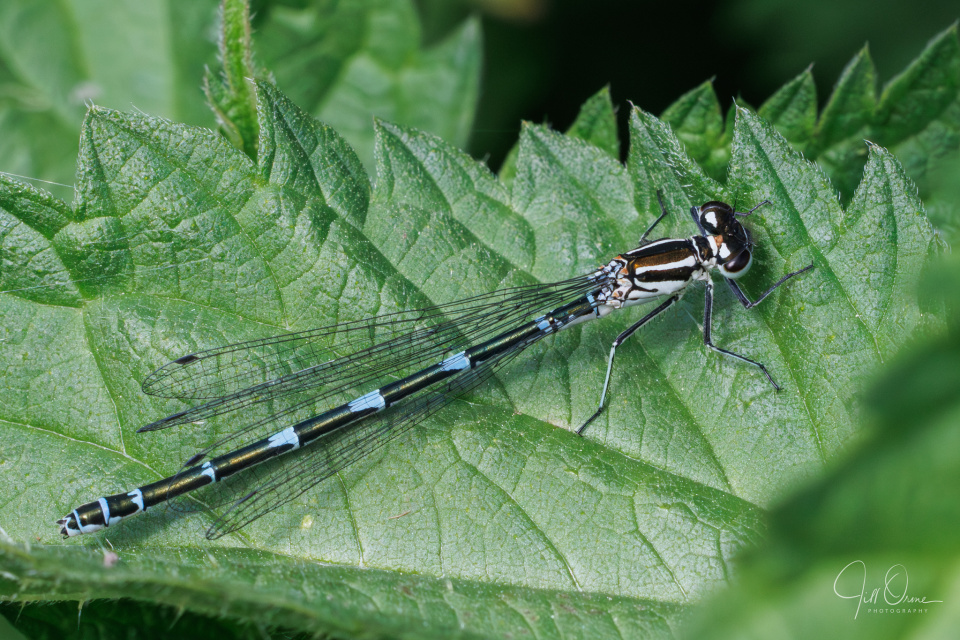
This female Azure Damselfly (Coenagrion puella) isn’t the first of her kind I’ve recorded this year, but she’s the first I’ve found locally, and though it doesn’t take me long each spring to get to the “just another blue damsel” stage, I haven’t arrived there yet this season, and I think she’s rather elegant. On emergence all her coloured markings were putty pink – and I think you can still see a hint of that around her head and thorax – but they’re now in the process of turning blue. The typical female Azure is black and green, with very limited colour on the abdomen, but this one is the form that some authors simply call blue, and others refer to as variegated. Even when she’s fully mature though, she’ll be darker than a male Azure, whose blue markings are always extensive.
I had two unexpected encounters at the Mill this morning. The first was with a good-sized Slow Worm I’d failed to see basking in a sunny corridor between two nettle beds, and which startled me by slithering away quickly into the undergrowth as I walked towards its sunbathing spot. I rocked back on my heels and squeaked, then laughed and apologised: “Oh, mate – sorry! I didn’t see you there!” I was then deeply embarrassed when I realised that someone else had come into the clearing, and was now standing about fifteen feet away from me, well within earshot of my exclamation.
Because the ground didn’t immediately save me by opening and swallowing me up, I decided that I’d better try to retrieve some shreds of dignity by speaking to this woman as if I was a normal person, and we exchanged a few minutes of pleasant (and potentially useful) chat. She was there to survey the local footpaths on behalf of the County Council, and after spotting the burnt-out car which is still sitting on top of my favourite fishing peg, she’d walked across the clearing to photograph it on her phone. She described it as a potential environmental hazard – which I’m sure it is, because every time it rains pollutants must get washed out of it and down the bank into the river – and was trying to decide who best to contact to try to have it removed. I was able to tell her that the BAA owns the land, but in the end she said that the problem was probably best passed on to the Environment Agency, and she promised to call them once she was back in the office. I’d pretty much resigned myself by now to the car becoming a permanent fixture of the Mill, but this has given me a shred of hope that at some point the horrible thing might be removed.
R: L2, C9, D7.


