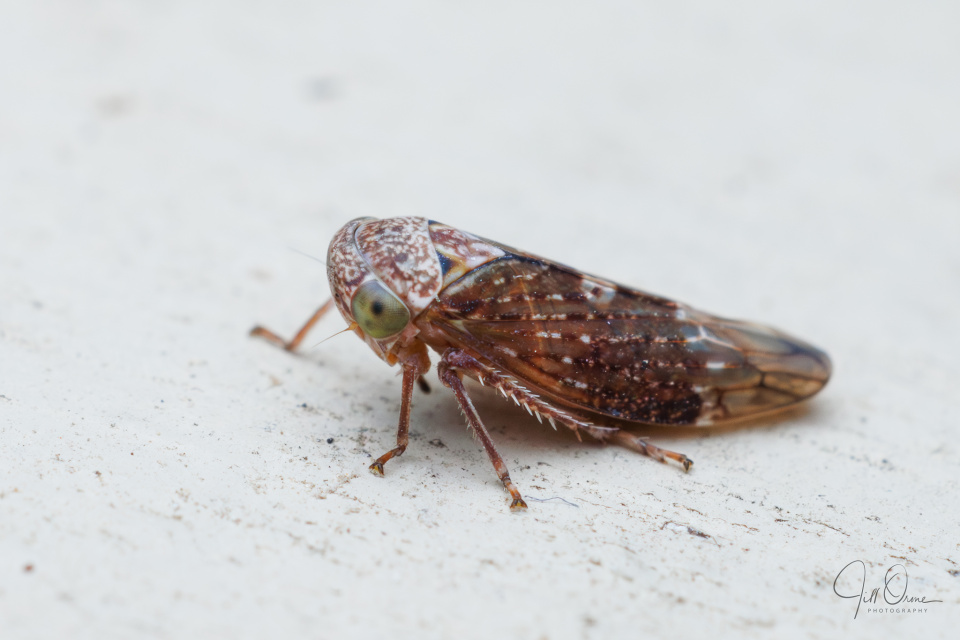
What with one thing and another, today didn’t feel like a day for going out, so I contented myself with a garden mini-beast safari. I tapped this leafhopper – which definitely counts as a mini-beast, being only around 6mm long in real life – out of the Lawson cypress, which is always insect city, and unlike the larger and brighter hopper I’d failed to catch or even identify just a few moments earlier, I managed to pop an inverted bug pot over her before she could either leap or fly from the beating tray. She was Not Pleased, and pinged furiously around the inside of the pot, but once I’d set it down on the painted seat of the nearby arbour she calmed down, and when I cautiously removed the pot she sat quite patiently while I photographed her, first from above and then again from the side. Then she strolled casually to the edge of the seat and paused for another second or two, before spreading her wings and flying away.
She is either Acericerus ribauti or Acericerus vittifrons – females of the two species being so alike that they’re very hard to distinguish – but as common things are commonest, and the former is the species for which I have the most verified records, I’m plumping for A. ribauti. Had she been male, I’d have been able to confirm the identification from a short dark facial bar (much longer and more pronounced in A. vittifrons males), and from the antennal palettes (to you and me, little blobs on the ends of the antennae), which in A. ribauti are short compared with the overall length of the antennae, but in A. vittifrons are significantly longer. Sadly neither of these features is present in the females, allowing them to retain at least an element of their feminine mystique.
Both the Acericerus species (previously called Idiocerus, which always seemed a bit insulting to me), are strongly associated with field maple, which we do have in the garden, but in my experience they have quite broad tastes, and I frequently find them in other trees as well.