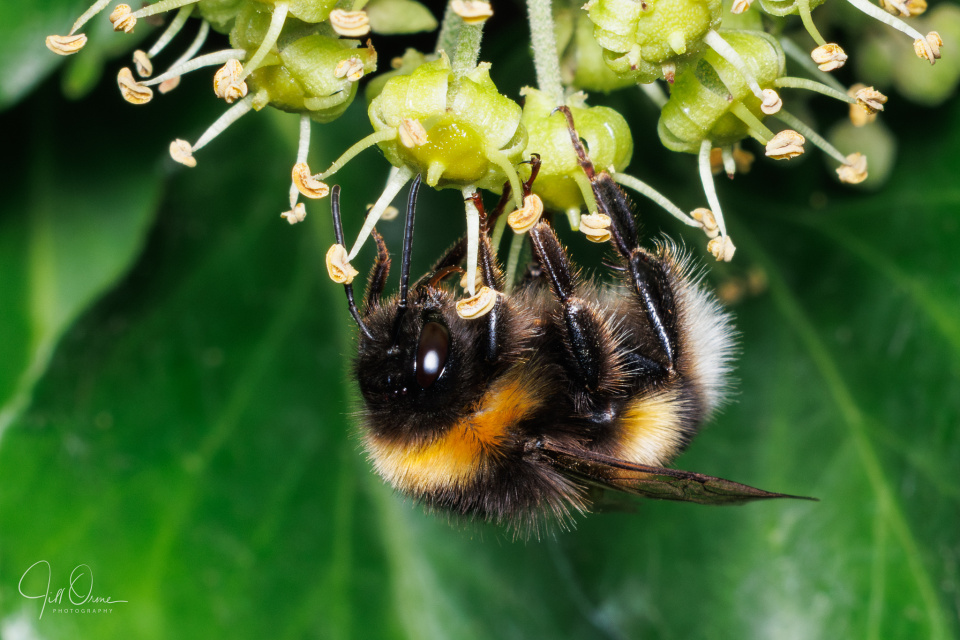
I had very little time for playing this morning, in advance of a visit by both Offspring and both grandsons, and unlike yesterday morning it was overcast, windy, and quite cold, so even the ivy wasn’t attracting many customers. I was struggling to get close to the few honey bees that were still working womanfully in spite of the conditions, when I was saved from mounting frustration by the arrival of this bumblebee.
These days I think of myself as fairly competent when it comes to identifying bees, but some are tricky, and I’m still not confident that I can successfully distinguish between a Buff-tailed and a White-tailed Bumblebee, if the former has a white tail with no line of brown hairs between the tail and the furthest black band. I was inclined to plump for this being a White-tailed Bumblebee (Bombus lucorum), but if I had, I’d have been wrong. When I posed the question to the BWARS group on Facebook, one of the experts promptly replied that the first thing to look at in a case like this is whether the bee is male or female, and suggested that once I’d realised it was a male bee, I’d have had my answer: male White-tailed Bumblebees always have at least some yellow hair on their faces, whereas male Buff-tailed Bumblebees have all-black faces, as this specimen does.
Which just leaves the vexed question of how to tell whether a bumblebee is male or female. All the texts advise looking at the tibia of the hind leg, which in a female bee is thickened, shiny, and concave, to allow for the collection of pollen balls, whereas in male bees it’s more slender, rounded, and uniformly hairy. Personally, I would have said that this bee’s back leg was thickened and shiny, but I guess – as with so many other things – it’s a question of degree. The BWARS expert specifically told me to look at the shape of the apex of the tibia, which would be sharply angular in a female’s leg, but is quite rounded here. As a clincher, she pointed out the length of this individual’s antennae – female bumblebees having just twelve antennal segments, whereas males have thirteen. After counting the segments myself (so you don’t have to, though you can if you like), I’m finally convinced: this bee is a male, so despite the extreme whiteness of his tail, his entirely black face means that he must be a Buff-tailed Bumblebee.
Second only to days when I find an interesting creature I’ve never seen before, my favourite days are the ones on which I learn something new or useful.