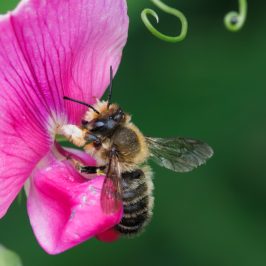

The sun came back out today, and brought with it the Hairy-footed Flower Bees. When I got tired of chasing them I went for a little wander up and down the lane, and on a whim veered onto the driveway of our next-door neighbour’s house (knowing that they won’t mind the incursion), to see if the sunny gravelled parking area was attracting anyth-
AAAARRRRGGGHHHH!!!! Bee-fly!!!!
DO NOT SCARE IT OFF!!!!
DO NOT:
1. approach too fast
2. move the camera too much
3. twitch
4. breathe
5. give the slightest sign of being even remotely interested in it!
So there I was, gliding slowly towards the bee-fly, while trying to look as uninterested as a person pointing a 100-500mm lens can possibly look, when it was bounced off the grape hyacinths by a Plumpie. At this point a few choice words were muttered, but luckily this specimen was made of sterner stuff than they generally are, and it soon returned to carry on feeding. In fact it was positively insouciant – once I’d finished trailing it all round the grape hyacinth patch with the long lens I went and fetched the macro and flash, and photographed it again from close quarters, without it ever seeming to notice that I was there.
So. This is a male Dark-edged Bee-fly (Bombylius major). This species usually emerges a little earlier than the larger, noisier and generally more assertive Dotted Bee-fly (Bombylius discolor), but even so, this is the earliest date on which I’ve ever recorded one – the third week in March is more normal here, and back in 2018 I didn’t manage to find one until 6th April. My second-earliest record was on 12th March 2017, when the roosting male I stumbled over turned out to be only the fifth specimen recorded that season, but this year I’m way off the Bee-fly Watch leader board: the first of the year was recorded on 25th February in Surrey, and last week the first sightings for both Wales and Scotland were reported. In fact, the up-to-date results page tells me that so far this season there have been 85 reports from 72 recorders around the country, including one sighting of Bombylius discolor.
Because this project has been running for so many years now, the dipterists behind it have enough data to assert that the bee-fly emergence date each year is closely tied to early spring levels of temperature and sunshine, and given that so far it’s been quite an up and down spring here, I’m going to forgive my guys for not managing to get out ahead of the bee-flies in Surrey and Guernsey.
R: L2, C6, D13.