I had to put my car into the garage in Stratford this morning for its 30,000 mile service – a milestone I seem to have reached ridiculously fast – and R came along for the ride. Once I’d handed over the car we walked down to the river and did the south/north circuit between the Old Tramway and Lucy’s Mill Bridges. Then we went to BTP and had lunch, before collecting the car and heading home. The whole thing would have been pretty much painless, but for the fact that the front nearside tyre turns out to need replacing, and the workshop was so busy that they couldn’t do it today. So I have to go back again in about ten days time.
I had my camera with me in Stratford of course, but failed to spot any interesting birds anywhere in town. I also had a bit of a rummage in the bankside vegetation around Lucy’s Mill – in my view it’s too early and still too cold for Odonata to be emerging from the river, but my mantra is that if you don’t look, you won’t find, so I had to check it out – but in the event the single interesting invert I spotted was an immature Furrow Orbweaver spider in a nettle bed, and it was so tiny that even at 500mm and minimum focus distance it was minuscule in the frame.
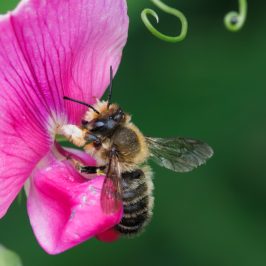
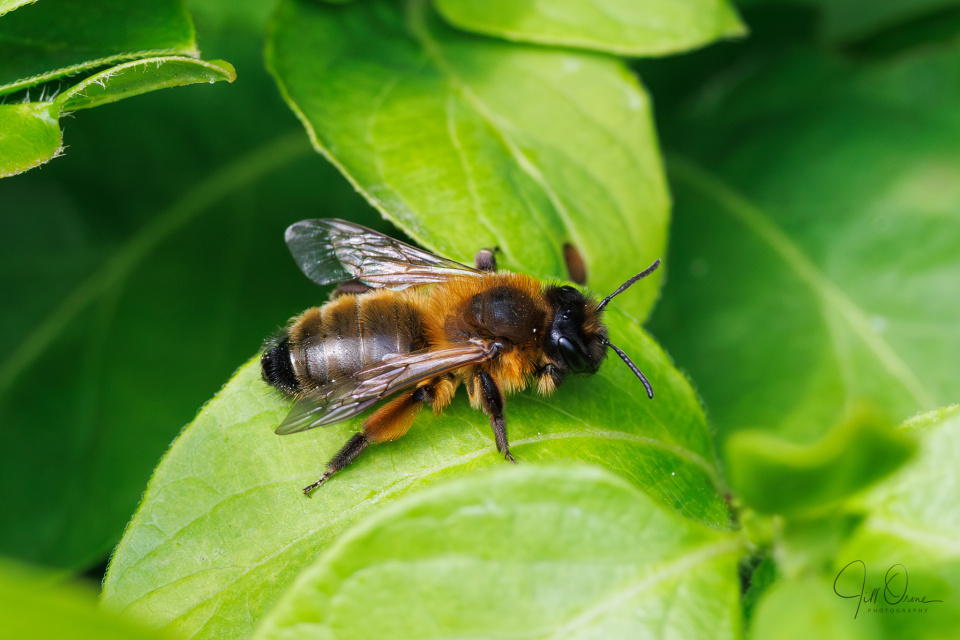
So when we got back home I rattled round the garden to see what else I could find, and of the bees and hoverflies that were still out and about that late in the afternoon, the most beautiful by far was this female Buffish Mining Bee (Andrena nigroaenea). I never write that common name without experiencing a little flash of annoyance on behalf of the bee (which of course neither knows nor cares about either the name it’s been given by humans, or my inclination to defend it against being damned by faint praise). Honestly though – does she look “ish” to you? She’s absolutely gorgeous – I think that from now on I’m going to refer to her as the Buffest Mining Bee.
If you can tear your eyes away from her and would like to read more about the species, Steven Falk is the man to go to, but I did also glean one other fun fact from the interwebs that I’d like to share with you: within the man-made limestone habitat at the Prudhoe Spetchells in Northumberland, there’s an aggregation of mining bee nests that’s believed to support over 100,000 bees, of which Andrena nigroaenea are by far the most abundant.
R: L2, C8, D7.