I had to go to Waitrose in Stratford this afternoon, in search of some items that Ocado hadn’t managed to deliver, and I used the excuse of this trip to make another tour around my nearest Odonata sites. There was nothing showing in Cleeve Prior, other than yet more Brassica Shieldbugs having a tiny Shieldbug orgy, but I did find a handful of Banded Demoiselles along the river bank at Barton.
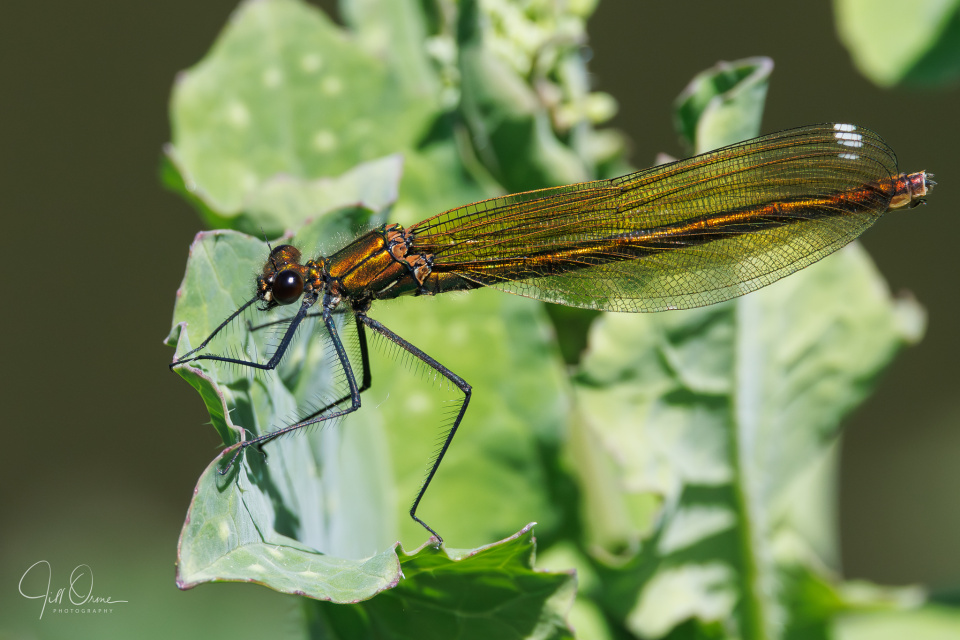
Three of the females were this deep gold colour, which is more common in Beautiful Demoiselles than their Banded cousins, and given that both species occur at this site I almost convinced myself that this specimen – the first one I came across – was Beautiful. But after a bit of careful edging about I managed to get some reasonably clear images of the back of her head, and when I enlarged them I could see that the tubercles behind her eyes are little more than vague bumps, whereas in a female Beautiful Demoiselle I’d expect them to be clear and prominent. This is a more reliable distinguishing feature than the position of the false wing spot, which is usually said to lie a little further along the straight fore edge of the wing in a Beautiful Demoiselle and more obviously on the curved wing tip in a Banded female. In my experience though, it can be quite hard to make that distinction in practice – especially given that a minority of female Demoiselles don’t have a false wing spot at all.
Happily the four females I photographed today – three gold and one green – all had wing spots, and my photos show that the positions of these spots matched perfectly. Adding this to the fact that none of the four had obvious post-ocular tubercles, I’m happy with my field assessment that all of them were Banded Demoiselles.
R: L2, C8, D16.