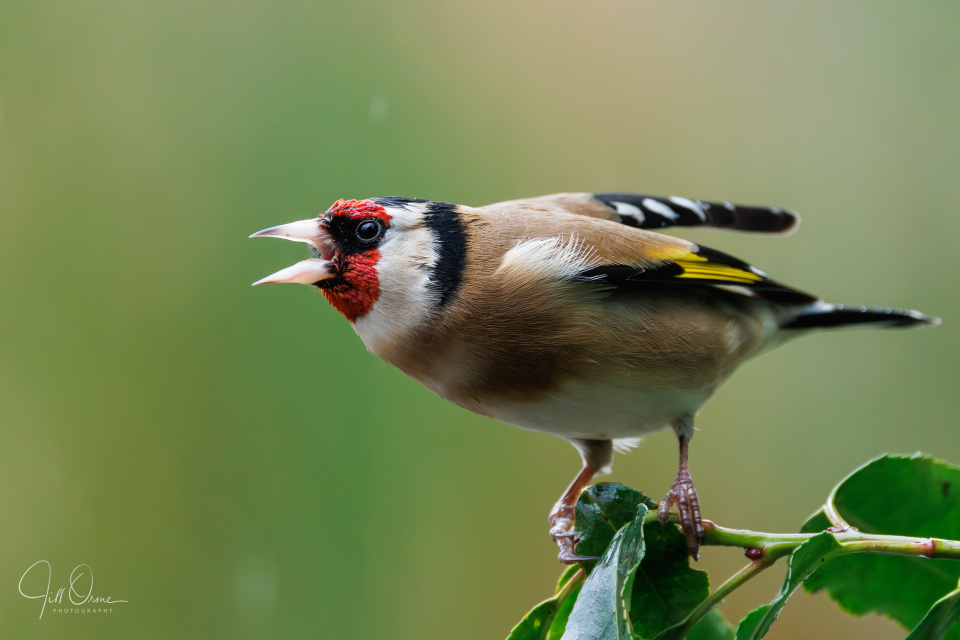
When I say, as I do quite regularly, that Goldfinches aren’t as charming as their collective name and their melodious twittering might cause you to think they are, this is the kind of behaviour I have in mind. This male (red feathers behind the eye; long, curved bill) was literally screaming at the other finches on a nearby seed feeder, presumably in an attempt to intimidate one of them into vacating their perch so that he could commandeer it. You can insert your own fantasy steam of abuse here; in my head he was either Father Jack Hackett, or maybe Bruno Ganz playing Adolf Hitler in the scene towards the end of Downfall that later spawned a thousand memes.
While all of this unbecoming behaviour was taking place just to the side of the hide window, some other birds were also waiting in the rain, either deeper inside or higher up on the laurel, for their own chance to feed. It took me a little while to spot the Greenfinch in my second photo, because the top of the hide window is quite low, and he was hidden from my sight line until I leaned over to an angle from which I could see right up to the top of the shrub. I like this bird so much that I almost featured him, but in the end I went with the shot that was harder to capture, and which I’m less likely ever to get again.
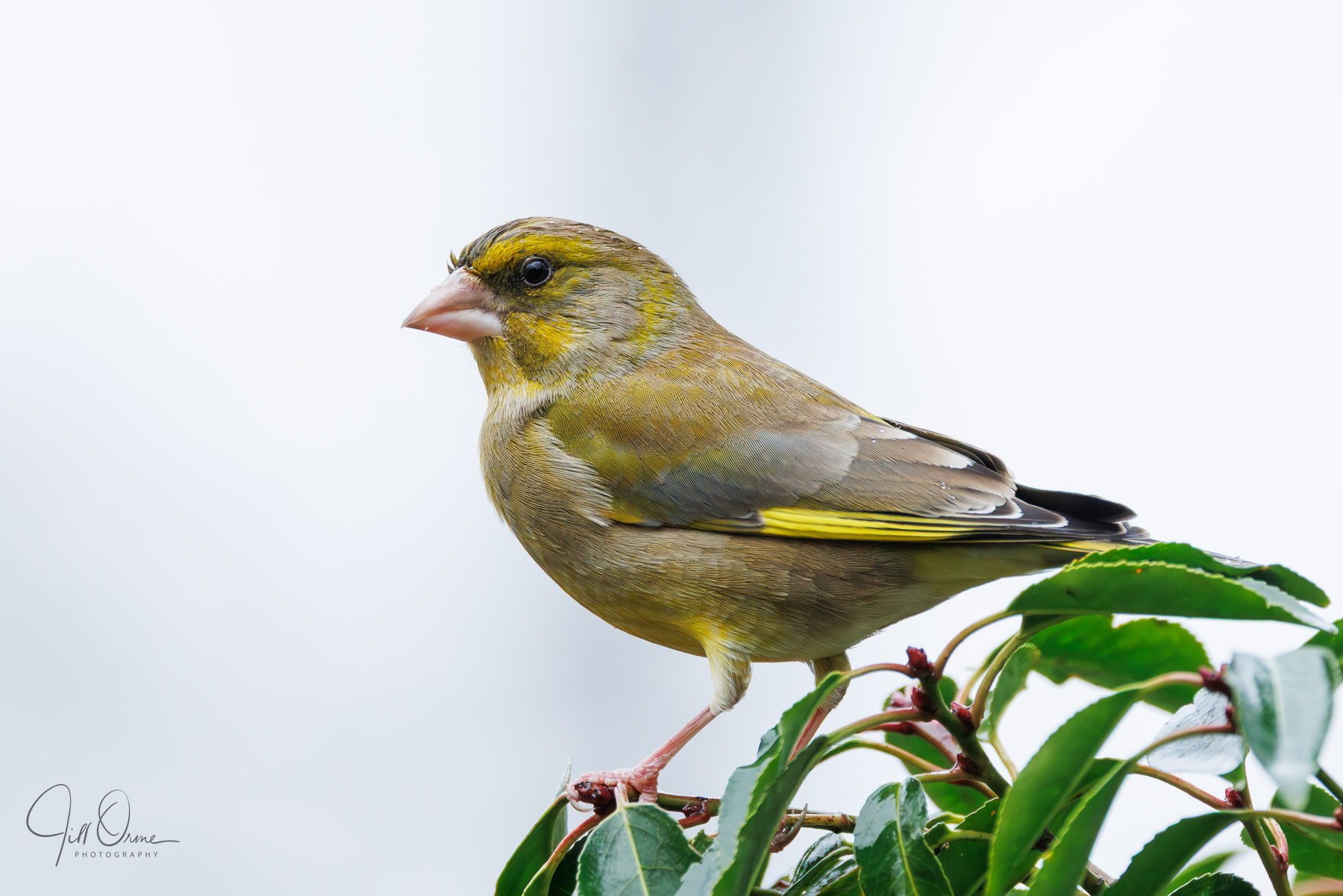
Although the Greenfinch is looking calm and reserved in comparison with the Goldfinch, I wouldn’t want to give you the impression that the species is shy and retiring, because it’s not: this is quite a large finch – about the size and weight of a House Sparrow – and it can be aggressive, especially in competition for food. It’s certainly more than capable of holding its own against the other finches using the woodland clearing today, none of whom would come in at much above half the Greenfinch’s weight. But I suspect that this is a first-winter bird, which might explain him being less pugnacious than some of his relations. I think he’s pretty splendid already, but as with many other finches his plumage will brighten over the next few weeks, because the new feathers that grow after the autumn moult are pale-tipped, and it’s only when these pale fringes wear away, which they do over the course of the winter, that the birds’ full breeding colours are revealed.
In other finch news, the first bird I photographed, just after walking into Hillers’ hide this afternoon, was a male Brambling, feeding on the ground with a small flock of Chaffinches. Sadly when they took fright and flew away, so did he, and though they came back to the clearing quite quickly, I didn’t see him again. I’ve only kept one record shot of him extracting fallen bird seed from a muddy puddle, but a sighting is a sighting, and he takes my bird list for the year to 96 species.
R: L2, C5, D7.