R and I went to Croome today, for lunch and walking, and for me to search the watercourse for Odonata. Sadly, R had already headed back to the visitor centre by the time I came across these Stonechats, and missed sharing an interesting encounter.
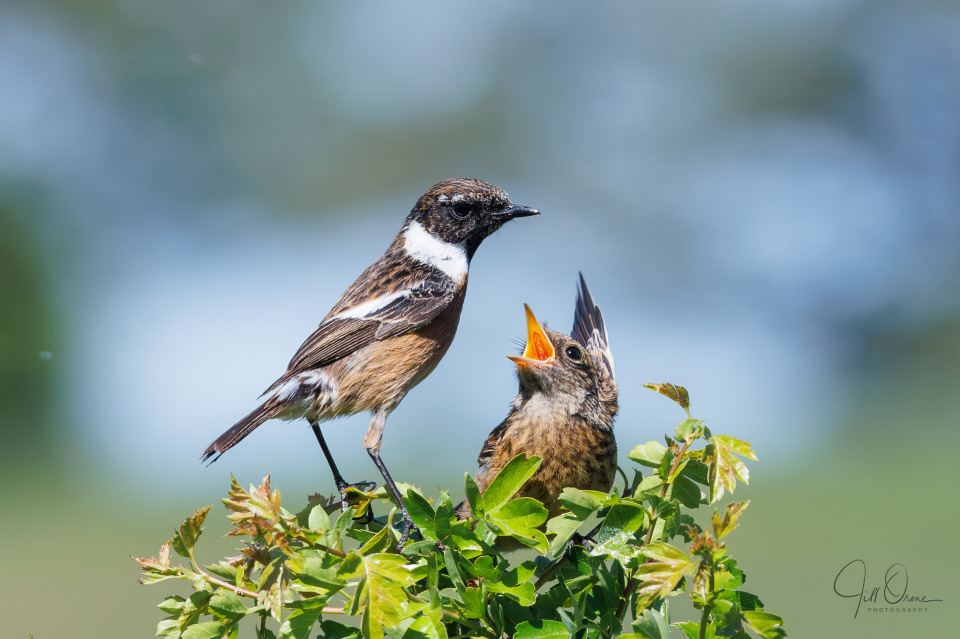
I first saw the male sitting on a tree guard, looking all around and calling regularly, while this female perched in a hawthorn tree, and a second one sat quietly but rather fetchingly on a wild rose stem nearby. After a while he dived into the grass, plucked a fat green larva from its previously peaceful existence, and flew with it to the top of a small hawthorn bush. He then paused for a few seconds, looking from side to side as though he couldn’t decide which way to go, which gave me plenty of time to secure some photos. But when he took off again to take his offering to the female in the tree, he moved much faster than I did: by the time I’d panned and refocused the caterpillar was nowhere to be seen, and she was begging for more. I think we’ve all known women like that, and not all of them have the excuse that they need the nutrients if they’re going to be in good enough condition to lay a clutch of eggs.
Now, this might just be me, playing the Great Anthropomorphiser as usual, but I thought at the time – and looking through my photos I’m still a little inclined to think now – that the male was less than thrilled with his potential mate and her demanding behaviour. For the next few seconds her begging became more and more extravagant, ending up almost in his face, while he completely ignored her and stood gazing downwards to the right… where the second, quieter female was perching. Eventually this one stopped gaping at him and closed her bill, and at that point the male gave a single squawk and flew off. I assumed he’d soon be back with another invertebrate gift, but after about five minutes the female in the tree left in the opposite direction, and a couple of minutes after that I also gave up, and walked on to the visitor centre in search of R and another cup of coffee.
I’d like to have known how the story ended, but in the interests of journalistic integrity, I must admit here that my fantasy of a love triangle was probably just that. The RSPB suggest that Stonechat pairs are monogamous, and the BTO state that in general courtship feeding occurs after mating, rather than before – and with the Stonechat’s nesting season running from March to June, and the time span for raising a brood being only about five weeks in this species, it’s likely that this pair has already kicked out one batch of juveniles and is preparing to nest again. Still though – his eye did look to be straying towards that mysterious lone female, and I never won’t wonder if he was feeling the lure of the unfamiliar.
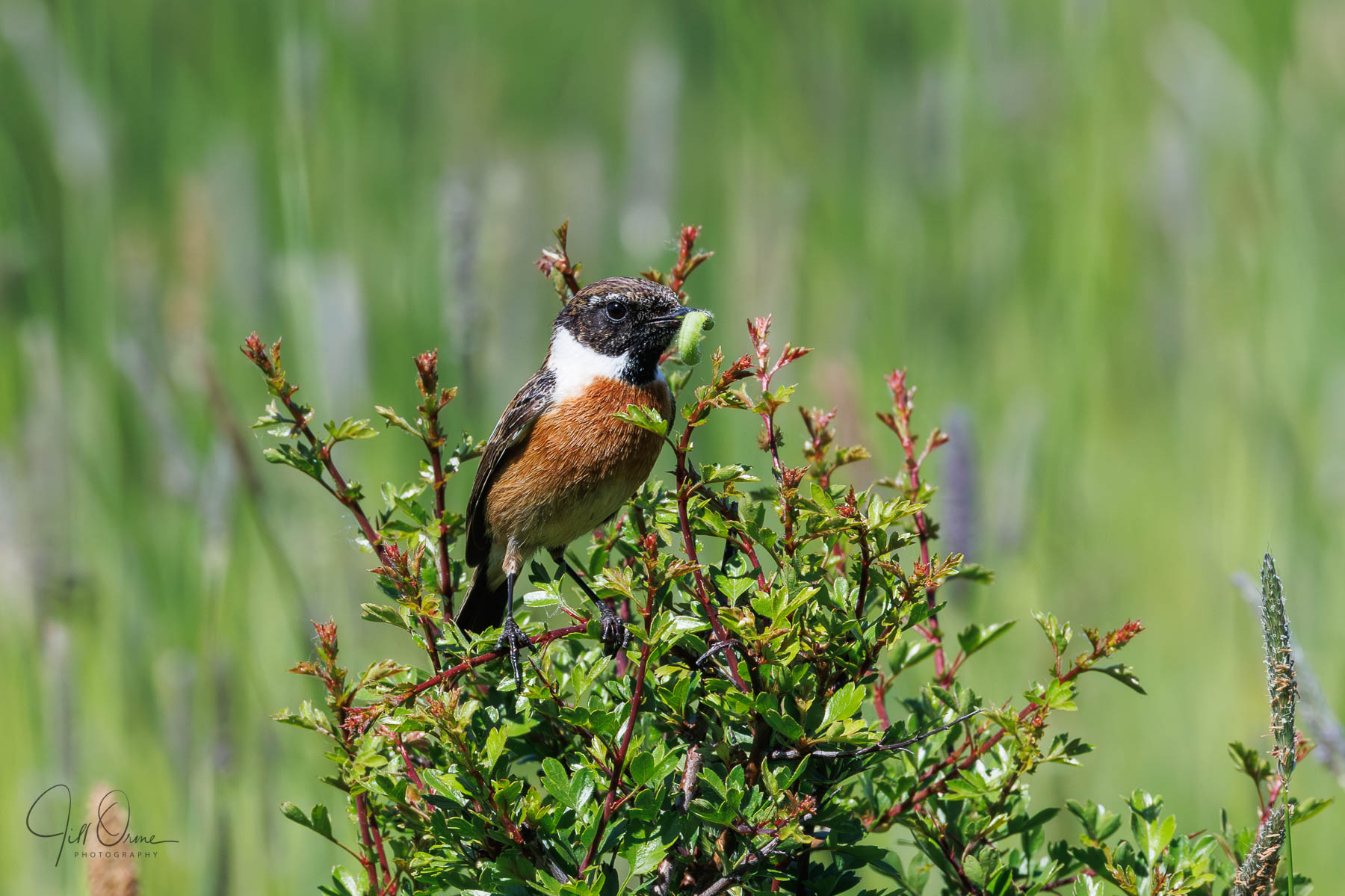
My second photo shows the male with the caterpillar he’d found, about a second before the two of them made the leap into hyperspace and rematerialised on the tree. I don’t often wish there was more than one of me, but just for a few minutes there it would have been useful to have had a photographic clone: we could have followed one bird each, and pooled our shots afterwards. She’d have needed to provide her own gear though – I’m not made of money.
Also seen at Croome today: a single female Azure Damselfly (my first of the year); a handsome male Reed Bunting; a fresh Small Copper butterfly; and Mr Richard Clifford, photographer of this parish. Seen very vaguely through layers of reeds, but heard almost incessantly: several Reed and Sedge Warblers, whose chuntering I have to rely on the Merlin app (buggy as its current build is) to separate. Neither heard nor seen, sadly: the Nightingales I know are present in the woods. Maybe next time for those.
R: L2, C8, D21.


