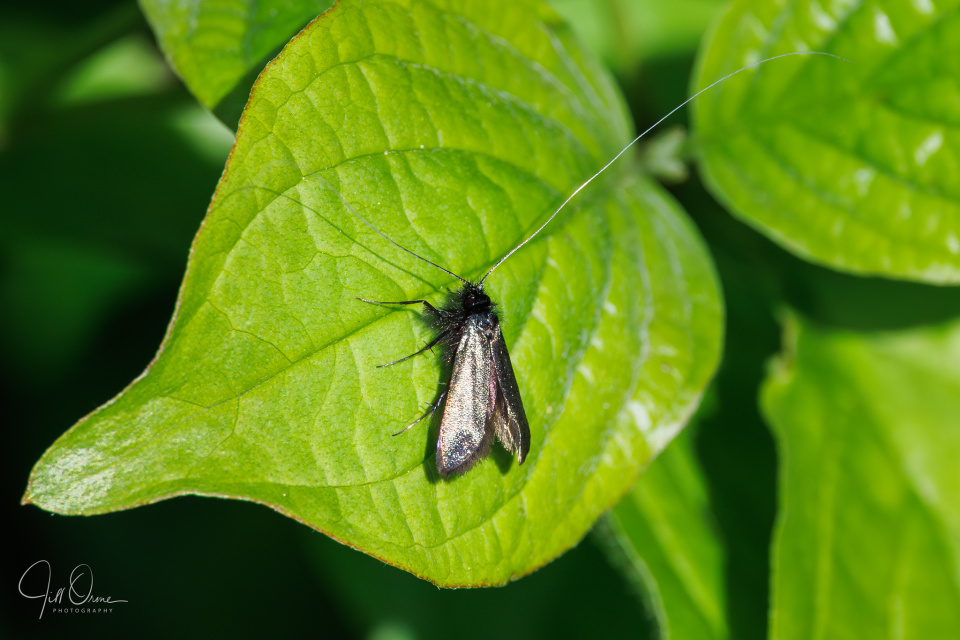
I’ve posted various longhorn beetles here previously: Wasp, Small Poplar Borer, and Lesser Thorn-tipped (several times), and once I even got a longhorn cow when I was aiming at some Cattle Egrets, but I don’t believe I’ve ever posted one of these glittery little moths before. It’s a Green Longhorn (Adela reaumurella), a name which always makes me wonder if the person who coined it had ever had the concept of green explained to them – even the greenest of the examples on the Butterfly Conservation page is self-evidently gold, and most, like this one, occupy a space somewhere between bronze and pink.
Anyway, whatever anyone else calls it, I will for ever think of this little creature as the Gold Lamé Longhorn, because it looks as if it’s glammed up for a party. The males, of which this is one – females are quite similar, but have slightly thicker and shorter antennae, and brown hair on their heads – also behave as though they’re at a party, coming together in a sunny spot and doing a wild pogoing flight up and down in the air, in an attempt to impress the ladies. Mayflies put in the same kind of effort, of cause, but despite the special moult they have to go through before getting stuck into the dancing, they don’t go in for flashy tailoring like this. When you see a group of these little moths dancing around a woodland glade, the sight is so magical it almost brings tears to the eyes – so it’s charmingly appropriate that the family of moths to which this species belongs are colloquially known as the fairly longhorns.
By the way, there’s one statement on the Butterfly Conservation description that I think they really should have explained more fully: The caterpillar lives in a portable case. Say what now?? My imagination skitters about between Terry Pratchett’s Luggage, The Importance of Being Earnest, and Macbeth’s Birnam Wood… and it turns out that it’s the last of these that’s actually relevant. Wikipedia explains that the larvae feed on leaf litter, and camouflage themselves by making “an oblong, brown, bag-like structure” from pieces of fallen leaves. They live inside their bags through the summer and winter, then pupate inside them in the spring, before emerging to live their best, glittery, but sadly short adult lives.
R: L2, C8, D13.