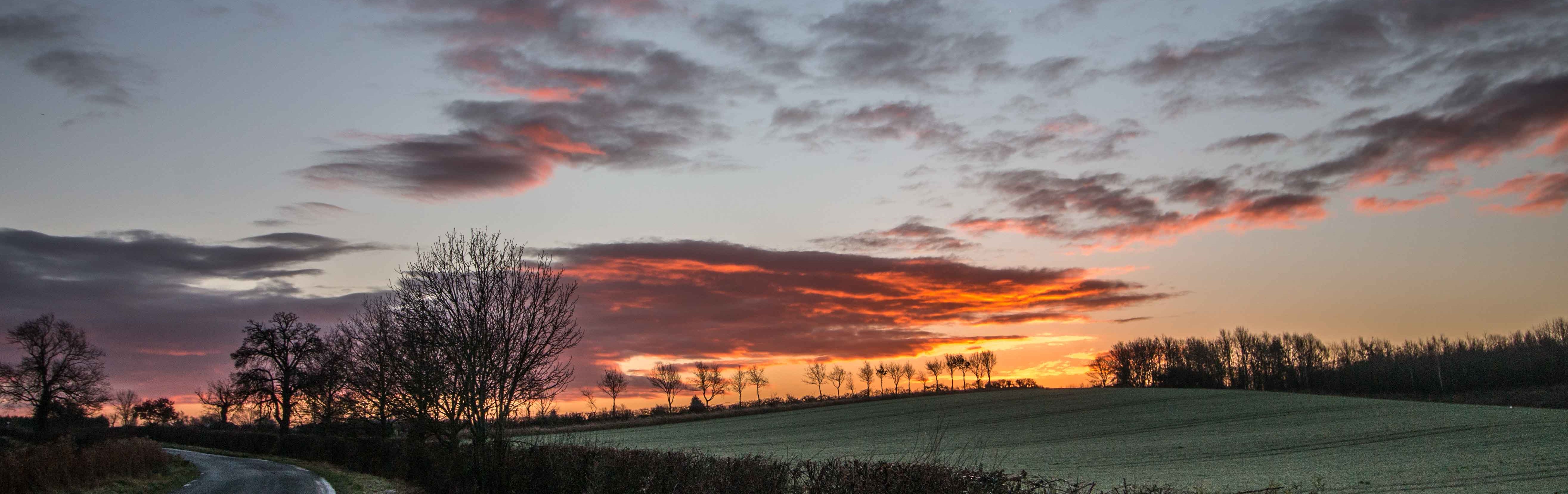
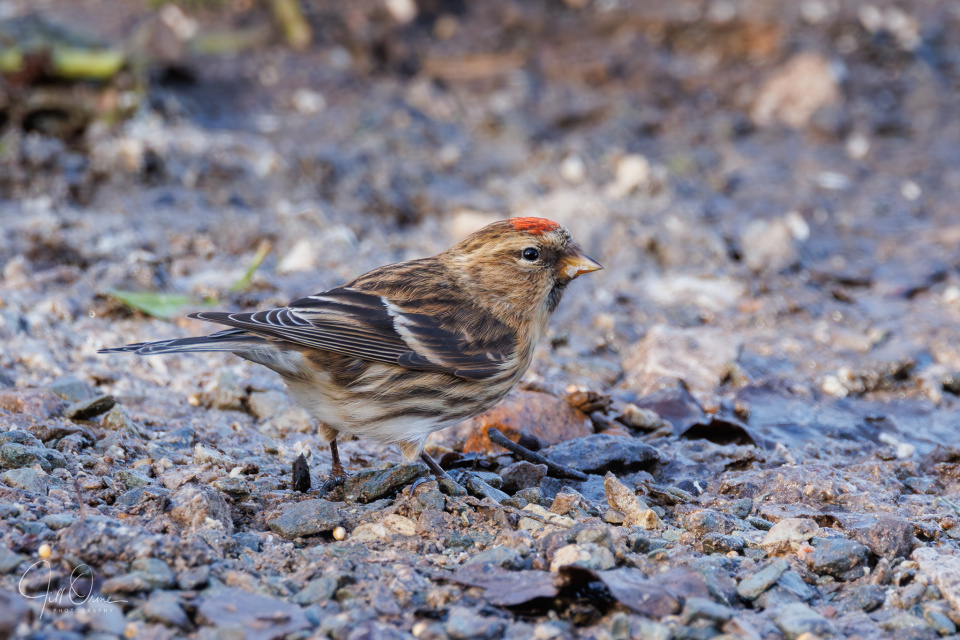
I was in a properly maungy mood this morning, largely because the weather continues to be so very depressing. It wasn’t actually raining though, so I headed up to Hillers in search of birds. Best of the day list-wise was this little Redpoll, though it lost points for being far more interested in feeding itself than in posing against a pleasing background.
Grump, grump, grump.
Redpolls are resident in Scotland, Wales, and Northern Ireland, but they’re not even common there, and in England they’re a relatively scarce winter visitor: I tend to see one or two each year, but rarely more than that. The BTO estimates the national breeding population at around a quarter of a million pairs, but Redpolls are difficult to count, so no-one knows for sure how many there are. Sadly, what does seem to be known is that the population has crashed since the 1970s, and since 2009 this bird has been Red Listed in the UK.
Until last year Redpolls were divided by taxonomists into three species, which were almost indistinguishable and therefore presented two challenges to the English birder: firstly, finding one, and then secondly, deciding which species you’d found. This little brown guy would definitely have been classed as a Lesser Redpoll (Acanthis cabaret), which is by far the most common type in this country, and was regarded as a specifically UK species. But during harsh Scandinavian winters we can also be visited by their larger and paler Mealy Redpoll (Acanthis flammea), and sightings of this bird have tended to be particularly prized (and in my experience sometimes quite angrily disputed). The third species in the old classification was the Arctic or Hoary Redpoll (Acanthis hornemanni), a bird of the Arctic tundra and the birch forests of Greenland and Canada, which is an even rarer visitor to the UK.
But then, those wild and crazy taxonomists had a lumping party, and mashed the three species together under the single binomial Acanthis flammea. This has made life much easier for everyone (including the Redpolls, who’ve been quietly interbreeding for years, but don’t have to keep the fact secret any longer), but – *whispers* – knowing that you no longer have to agonise over the colour of its breast and the barring on its flanks has taken just a bit of the fun out of spotting a Redpoll. Happily though, the BTO are still tracking the movements of the Mealy and Arctic sub-types in and out of the country, so the Birdtrack app allows them to be listed separately from the natives, if you’re sure that this is what you’ve seen.
The only time I’ve ever recorded a ‘Mealy’ Redpoll, I also posted it here.
R: L2, C4, D13.


