R and I went up to Dunnington late this morning, to have lunch at Hillers. This also gave me the chance to spend forty minutes or so in the bird hide, while R caught up on some reading. It was a pretty horrible day, weather-wise – not exactly foggy, but the air was so heavy with moisture that a thick, cold, unpleasant-smelling mist hung over everything, and visibility in the clearing by the hide was quite poor. The feeding stations were all busy, though the birds were anxious and reactive, disappearing in a panic-stricken flurry every few minutes. This usually means there’s a raptor about, and Merlin thought it heard a Peregrine amid the general chatter, but to me this seemed unlikely – I always think of Peregrines as open air birds, using their phenomenal speed over a distance to catch up with fleeing prey, and a small clearing in misty woodland seems like the wrong kind of hunting territory for them. A Sparrowhawk, or even a Goshawk, would be much more likely – but in the time I was in the hide I didn’t see or hear any kind of raptor myself.
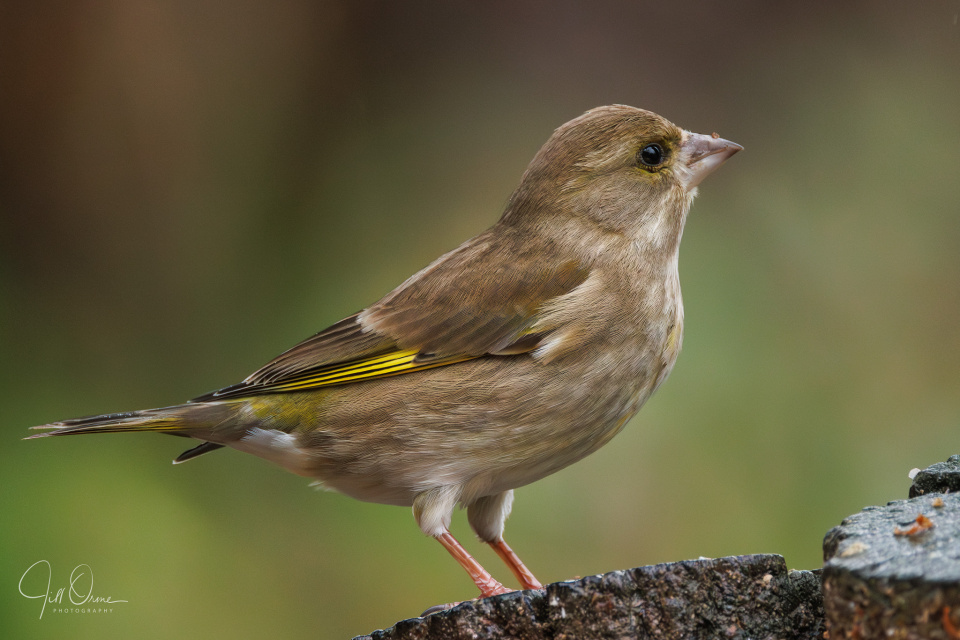
Despite the Stygian gloom I did quite well, photo-wise, but out of all my possible images I’ve chosen this one because it’s literally years (seven and a bit) since I last posted a Greenfinch. This is probably because they’re relatively uncommon these days – in my rural 60s childhood they were a numerous bird in and around farmland and on village garden bird tables, but since then their numbers have decreased by nearly 70%. The biggest fall, through the 70s and 80s, is blamed on changes in farming practice making it much harder for them to scavenge the grain and weed seeds they favour. Their numbers then picked up again for about fifteen years, but plunged in 2005 and 2006 due to a serious outbreak of trichomonosis – a disease which is particularly associated with Chaffinches, but which also affects Greenfinches, and is estimated to have reduced the European Greenfinch population by around 35%.
At Hillers the Greenfinches – which have only appeared as regular diners fairly recently – spend most of their time squabbling with the local Goldfinches for possession of the two hanging feeders filled with sunflower hearts, and it’s fairly unusual for them to visit the bird table, which is where I caught this individual. By now I’m sure you’ll have noticed that it’s not appreciably green, which makes it either a female or a juvenile – both of which are all too often described as “dull” and “chunky”. All I can say to that is, I know how they feel, and IMO there’s absolutely nothing wrong with being dull and chunky. At first sight I assumed that this was a dull and chunky female, but now I’ve been living with it for a while I’m more inclined to it being a first winter male, moulting out of juvenile and into adult plumage. Females tend to be a bit paler than this, and I’d say that the fading streaks on this bird’s breast and belly are the markings of a juvenile. The clincher is some hints of a stronger olive-green colour appearing on his breast and flanks and around his eye, which make me think that he’ll soon be much brighter and more flamboyant than he is now. Though still, in all likelihood, a bit of a chonk.
There are Greenfinch facts here and here, if you’d like to know more.
R: L2, C4, D4.


