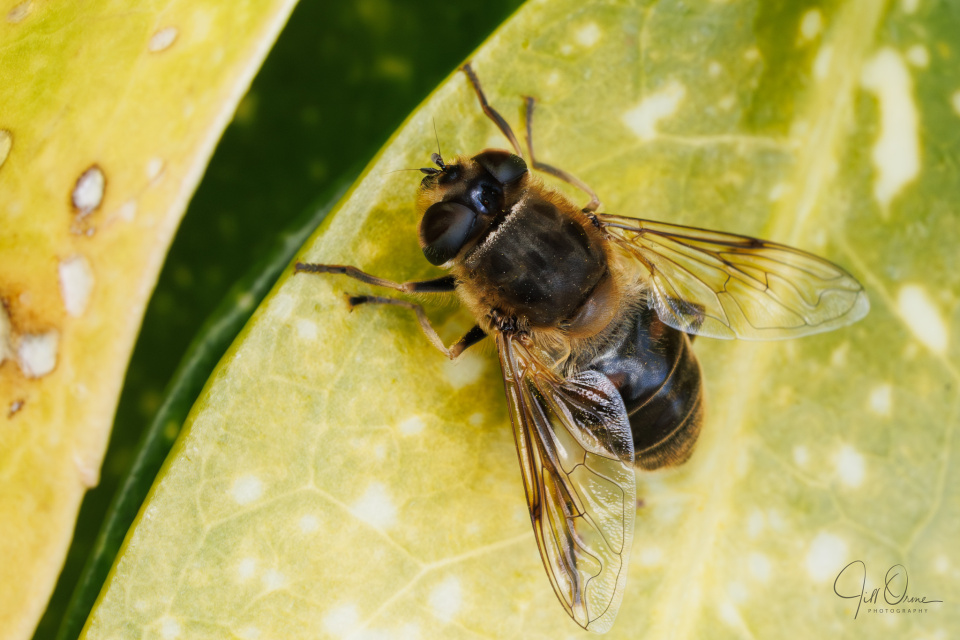
I was so delighted to spot this female Eristalis tenax on the aucuba this morning that I did a tiny dance. Since it got too cold for me to risk beating the garden bugs out of their shelters last autumn, she’s the first invertebrate I’ve had the chance to photograph – though I have to say that relatively speaking it’s been a mild and damp winter, and I’ve come across flies in sheltered spots throughout most of it.
It’s usually stated about hoverflies that the bulk of the insects’ life span is spent as third-instar larvae or as pupae, and that the winged adults only live for a few days, or at most a few weeks. Knowing this, it bothered me for years that I always seem to see a significant number of very fresh female Eristalis tenax in the autumn, right at the end of the main part of the season, and with so little time left for them to breed and fulfil their life cycles before the onset of the cold weather, I wondered if they might possibly hibernate. And now I know: according to Ball & Morris, Eristalis tenax females overwinter as adults, hibernating in sheltered cavities in caves or buildings, and emerge to complete their life cycles in the spring. As well as being pleased to know that this late-season generation of hoverflies isn’t “wasted”, I confess to feeling just tiny bit smug that a personal theory born from my own recording has turned out to be correct.
Because it was not just a sunny day but actually warm, with the temperature in the garden reaching the mid-teens, and insects beginning to appear, my thoughts turned – reluctantly – to gardening. I managed to avoid actually doing any by taking myself off for a recce around the garden centre, because I think you should always ease yourself into these things gently, but with the forecast looking good for the rest of the week, I might just break out the Stihl hand tools tomorrow, and do a little light tidying.
R: L2, C5, D17.