
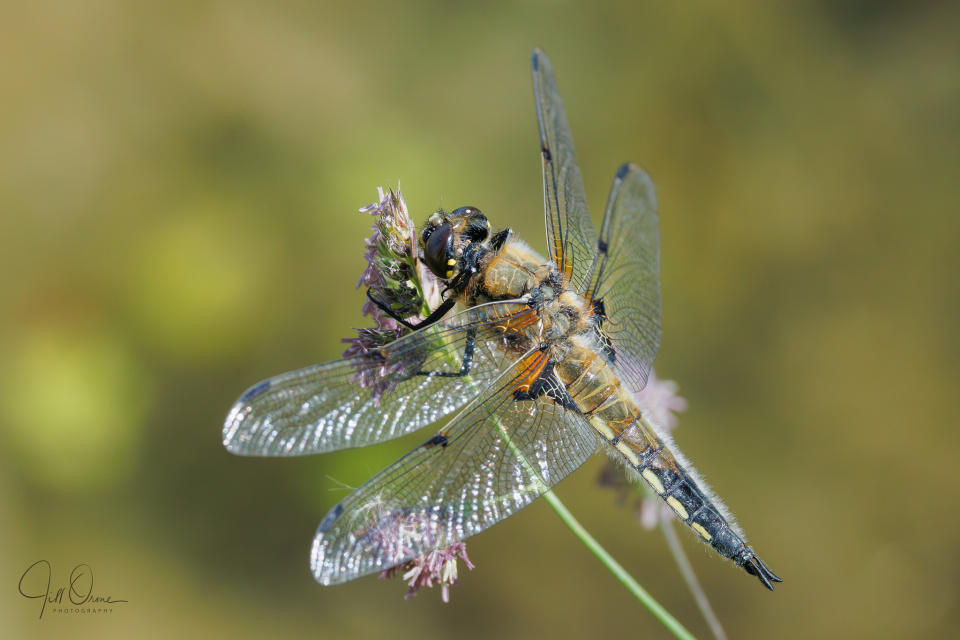
I love a Four-spotted Chaser – they’re such neat and energetic little dragons (Norbert dragons, the Boy Wonder would probably say). This particular male was top dog at the village pond this afternoon, repeatedly besting a second male who was holding a less desirable territory over on the shadier side, whenever his hunting sorties brought him a little too close to this bank. When a third male arrived, they both immediately lifted off and turned on him, but he refused to be chased away and there was quite a clash, with the wing-mashing soundtrack – like cellophane being scrunched into a ball – that always makes me wince.
Eventually Number Three backed off into the field and perched on some tall weeds a short distance away, and peace was declared, more or less, between the other two. Then though, a female Broad-bodied Chaser arrived, and all hell broke loose, with the three Four-spots chasing her furiously around the pond, all fighting each other while trying to grab her and force her into cop. All she wanted to do was to lay a batch of eggs, but she could only do this in fits and starts, while fleeing the amorous males and shaking them off when they managed to catch hold of her.
I’ve seen this behaviour before in Four-spotted Chasers, and once I even managed a blurry record shot of a female Broad-bodied Chaser and a male Four-spot flying together, apparently in cop, but while the two species are fairly closely related I’ve never read anything suggesting that they can actually hybridise. The behaviour is well-known though, and often reported: in Brooks and Cham’s Field Guide to the Dragonflies and Damselflies of Great Britain and Ireland, Steve Brooks writes about the territorial breakdown and aggressive dog-fighting that can happen among male Four-spots when there are too many of them at the same water body, and comments, “at high densities, males can be so frantic to mate that they will sometimes grasp female Broad-bodied Chasers.” He also says that on occasion male Broad-bodied Chasers may have difficulty distinguishing females of their own species from female Four-spots, but I’ve never personally seen an attempted cross-species mating in that direction.
The only thing about all of this that surprises me is that the female Broad-bodied Chaser was oviposting without the guarding presence of the male who’d fertilised her eggs, but Steve Brooks states that while oviposition usually takes place immediately after mating, if the female is being badly hassled by her partner wanting to copulate repeatedly, she might leave the site and come back later to lay her eggs in peace. If that’s what happened in this case, the female might have been better to have stuck with her man, because while they’re generally a bit quieter than Four-spotted Chasers male Broad-bodies do become aggressive after mating, and his defence of her would at least have distracted the Four-spot trio, and given his mate some room to manoeuvre.
I’ve chosen this image over a couple of cleaner ones because it’s unusual for a dragon to choose a perch as unsuitable as this: the grass stalk was too soft and pliable to hold his weight, and kept bending right over towards the water surface. Each time that happened he would take off and fly a quick sortie over the pond, but for some reason he favoured this stem over the tougher rushes nearby, and he kept coming back to it. I came up with a silly little fantasy that he was hoping to use the flowers to charm the female Broad-bodied Chaser, but if that was his plan I’m afraid it didn’t work.
R: L2, C10, D23.


