
It seems that our sweltering early summer is over, at least for now. Large amounts of rain are forecast to fall across the country next week – which to be fair, the farmers certainly need, and the rest of us could probably do with too, especially people living in areas that tend to be hit first when the water companies bring in hosepipe bans. Today was mainly overcast and noticeably cooler, and though it didn’t actually rain, with an inch or more threatened by the end of Tuesday R and I decided that it would be better to finish no-mow May a day early, rather than risk the grass putting on a further growth spurt while being too wet for us to tackle. We’ve left the wild flower meadow in the front garden, but R cut the top back lawn with the small electric push mower, and I took the tractor to the wild garden, where in places the grass was already waist-high. As you know, when it comes to my garden I’m a big fan of doing as little as possible managed neglect, so I didn’t feel great about all this tidying, but when I realised how hard the little tractor mower was having to work to get through the longest grass in the wild garden, I knew we’d made the right decision.
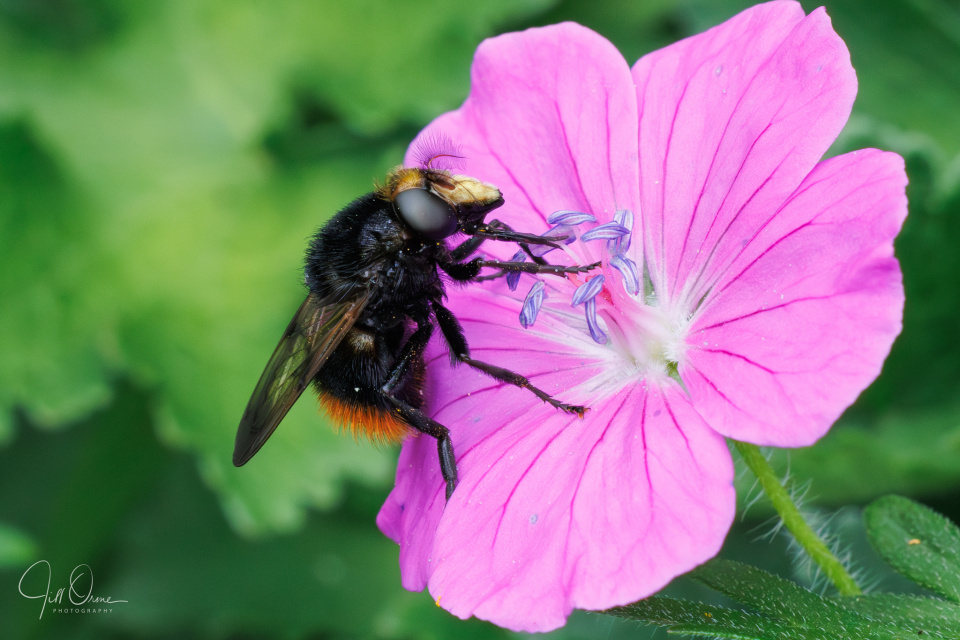
After putting away the mower I hand cut the jungle that had sprung up around the wildlife pond, and then topped up the water, which was dangerously low – even that promised inch of rain wouldn’t be nearly enough to replace what we’ve lost to evaporation during the hottest May on record. By the time I’d done all that I was hot, tired, hungry, and extremely grumpy, and just about the last thing I felt like doing was setting out on a garden bug hunt, but I often find that just one good invert can instantly switch my mood from stormy to fair – and today it was this handsome hoverfly that performed the trick.
We have five species of the genus Volucella in the UK, of which this one – Volucella bombylans – is the most common and widespread. Strangely though, while I often see it at reserves and other wildlife sites, I only very rarely find it in the garden. As the name bombylans suggests, it’s a bumblebee mimic, and it comes in three different colour forms. This black and red female has evolved to impersonate the Red-tailed Bumblebee, Bombus lapidarius, but there’s also a black and yellow form with a white tail that claims to be the White-tailed Bumblebee, Bombus lucorum, and a much rarer buff form that resembles the Common Carder Bee, Bombus pascuorum. It would be fair to say that none of them are terribly effective mimics, but they’d pass a cursory inspection, and that’s all a potential predator is likely to give them before deciding that they’re probably more trouble than they’re worth. The mistake this female made with me was to drift around the geraniums in a hovery kind of way: if she’d zoomed about with the furious concentration of a bumblebee, she might have passed my cursory inspection as well.
R: L2, C10, D10.


